The Man · The Messiah · The Light of the World
A celebration of the life, teachings, and soul of the most extraordinary figure in human history
"For God so loved the world that he gave his one and only Son, that whoever believes in him shall not perish but have eternal life."
— John 3:16
Enter the Kingdom ↓Every tradition that encounters him recognizes something extraordinary
The Christ Pantocrator of St. Catherine's Monastery at Sinai, a 6th-century encaustic icon.
Salvator Mundi (circa 1500), Leonardo da Vinci.
Christ Blessing (circa 1500), Giovanni Bellini.
Jesus of Nazareth was born in the time of Herod, lived under the rule of Rome, taught in parables and performed wonders, and died on a cross outside Jerusalem — only to rise again on the third day. According to the testimony of those who loved him and were transformed by what they saw, Jesus was the Son of God. He is the most written-about, most depicted, most debated, and most beloved human being who has ever lived. Over two billion people call him Lord. His words have shaped civilizations, inspired revolutions of conscience, and comforted the dying and outcast in every century since his own.
The Jesus who emerges from the full sweep of human encounter is larger than any single tradition can contain. The canonical Gospels give us the historical man: carpenter, healer, teacher, crucified Messiah, risen Lord. The Gnostic texts unearthed at Nag Hammadi reveal a cosmic revealer who awakens the divine spark. Islam honors him as one of its greatest prophets, born of a virgin and destined to return before the Day of Judgment. Buddhist-Christian dialogue discovers in him the bodhisattva of perfect compassion. Hindu sages recognize the fully realized yogi in whom Christ Consciousness is universal. Jewish scholars reclaim the Galilean hasid whose teachings are inseparable from the Judaism he practiced. Sufi mystics revere the Spirit of God whose very breath heals. Western esotericists trace in his Transfiguration and Resurrection the supreme achievement of the body of light.
Scrovegni Crucifix (1304), Giotto.
This site, or classroom, from the Invisible College is a celebration — reverential, intellectually rigorous, and radically open to the many ways humanity has encountered this singular figure across two thousand years. Whether you approach Jesus through faith, gnosis, meditation, scholarly inquiry, or simply human curiosity, you are welcome here.
What follows is the Total Jesus — the man, the myth (spoken archetypally), and the legend — told through the Gospels, the hidden scriptures, the wisdom of the world's traditions, and the words that have echoed through every age since a carpenter's son stood up in a Galilean synagogue and declared: "The Spirit of the Lord is upon me."
"I am the light of the world. Whoever follows me will never walk in darkness, but will have the light of life."
— Jesus, Gospel of John 8:12
Jesus was born into 1st-century Palestine under Roman occupation, a volatile landscape of imperial power, messianic expectation, and competing religious movements. Herod the Great had rebuilt the Jerusalem Temple on a massive scale but was despised for his brutality. After his death in 4 BCE, his kingdom was divided among his sons: Herod Antipas governed Galilee — the Herod who would later execute John the Baptist — while Judea fell under direct Roman rule through prefects, the most consequential being Pontius Pilate (~26–36 CE).
The Jewish world of Jesus's day was far from monolithic. The Pharisees emphasized Torah observance, the Oral Law, and believed in resurrection. These notions would survive the Temple's destruction to become the foundation of Rabbinic Judaism. The Sadducees, a priestly aristocracy controlling the Temple and Sanhedrin, accepted only the written Torah and rejected resurrection entirely. The Essenes lived in ascetic desert communities widely associated with the Dead Sea Scrolls at Qumran. Zealots advocated armed resistance against Rome. Languages spoken included Aramaic (the everyday tongue of Jesus), Hebrew (liturgical), Greek (administrative), and Latin (military).
Messianic expectations in Second Temple Judaism were wildly diverse: some anticipated a Davidic warrior-king who would restore Israel's political independence; others expected a priestly messiah, a heavenly figure, or a cosmic transformation. The eventual ministry of Jesus intersected with all these expectations — while confounding every one of them too.
Sistine Madonna (1513), Raphael.
"The Spirit of the Lord is upon me, because he has anointed me to proclaim good news to the poor. He has sent me to proclaim liberty to the captives and recovering of sight to the blind, to set at liberty those who are oppressed, to proclaim the year of the Lord's favor."
— Jesus, reading from Isaiah in the Nazareth synagogue, Luke 4:18–19
Christ between Four Angels (1496), Vittore Carpaccio.
The life and teachings of Jesus come to us primarily through the four canonical Gospels, each offering a distinct theological lens on the same extraordinary life. Mark (~65–70 CE), the earliest and shortest, is action-driven and emphasizes the "Messianic Secret" — Jesus repeatedly commanding silence about his identity. Matthew (~80–90 CE) writes for a Jewish audience, tracing Jesus's genealogy to Abraham, citing Hebrew Bible fulfillment at every turn, and presenting him as the new Moses delivering the new Law from the mountain. Luke (~80–90 CE) emphasizes universality, compassion for the poor and marginalized, and provides the most detailed narrative, including: the Nativity, the parables of the Good Samaritan and Prodigal Son, and the account of the road to Emmaus. John (~90–100 CE) is the most mystical and theological, opening with the Logos hymn — "In the beginning was the Word, and the Word was with God, and the Word was God" — and presenting the seven "I Am" statements that identify Jesus with the divine name itself.
Together they form a portrait that is at once human and transcendent — a man who wept at a friend's tomb, overturned the tables of merchants in holy anger, broke bread with outcasts and sinners, and spoke words that two thousand years later still have the power to bring a stranger to their knees.
"Do not think that I have come to abolish the Law or the Prophets; I have not come to abolish them but to fulfill them."
— Jesus, Matthew 5:17
"In the beginning was the Word, and the Word was with God, and the Word was God."
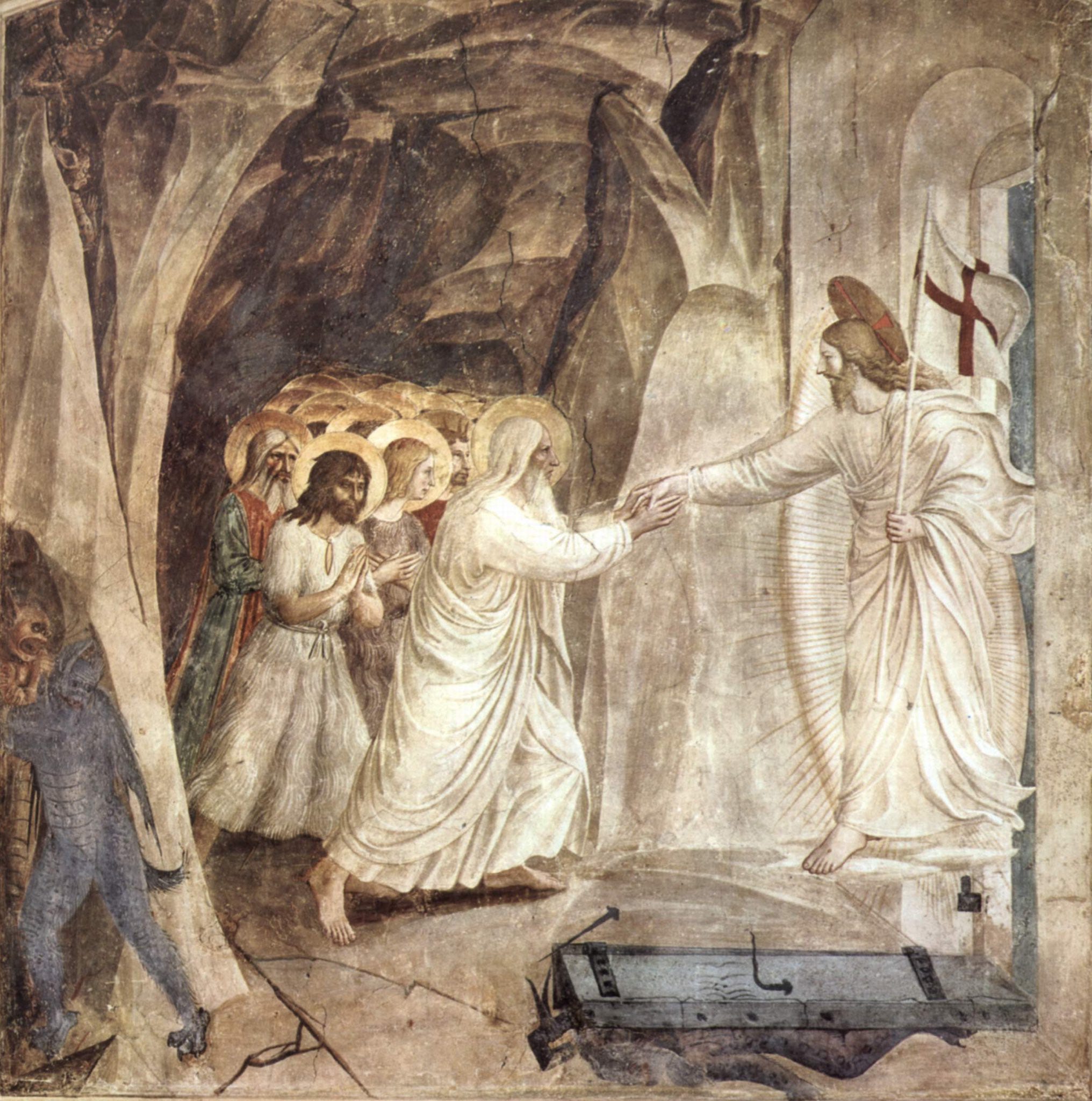
Jesus Christ grants salvation to souls by the Harrowing of Hell (1430s), Fra Angelico.
The Bible is the most printed, most translated, and most widely distributed book in human history — an estimated five billion copies in over 700 languages. It is not a single book but a library: a collection of 66 books (73 in Catholic tradition) written across roughly 1,500 years by dozens of authors in three languages — Hebrew, Aramaic, and Greek. The Old Testament (or Hebrew Bible) preserves the sacred history, law, poetry, and prophecy of ancient Israel. The New Testament, written entirely in the first century CE, tells the story of Jesus and the community that formed in his wake.
The word "testament" itself means covenant — a binding agreement between God and humanity. The Old Covenant, established through Moses at Sinai, bound Israel to God through the Law (Torah): obey the commandments, and God will be your God. It was written on tablets of stone. The New Covenant, prophesied by Jeremiah (31:31–34) and fulfilled in Jesus according to Christian theology, is written not on stone but on the human heart — a covenant of grace rather than law, sealed not by animal sacrifice but by the blood of Christ at the Last Supper: "This cup is the new covenant in my blood, which is poured out for you" (Luke 22:20). The two testaments are the stages in an unfolding story — the Old preparing the ground that the New would transform.
Supper at Emmaus (1601), Caravaggio.
The New Testament contains 27 books: four Gospels, the Acts of the Apostles, 21 epistles (letters), and the Book of Revelation. At its center stand the four Gospels — Matthew, Mark, Luke, and John — the primary witnesses to the life, teachings, death, and resurrection of Jesus Christ. The word "gospel" itself comes from the Old English godspel, meaning "good news," translating the Greek euangelion. These are not biographies in the modern sense; they are theological portraits, each shaped by its author's community, audience, and vision of who Jesus was and what his coming meant for the world.
The story of Jesus as told through these four Gospels is the most widely known narrative in human history. From the miracle of his birth in a Bethlehem manger to the glory of his Resurrection and Ascension, each event carries layers of theological meaning, prophetic fulfillment, and human drama. What follows is the arc of that life — from the star over the stable to the empty tomb — told through the key events that the Gospel writers chose to preserve.
Christ in the House of Martha and Mary (1886), Henryk Siemiradzki.
Click any event below to explore it further.
Only Matthew and Luke provide birth narratives, and they differ significantly. Matthew writes for a Jewish audience, emphasizing fulfillment of prophecy: Joseph's angelic dream, the star guiding the Magi from the East, Herod's massacre of the innocents, and the Flight into Egypt. Luke provides the census under Quirinius, the manger in Bethlehem, the angelic announcement to shepherds, and the Magnificat of Mary. Mark and John contain no birth narratives at all. The scholarly consensus dates Jesus's birth to approximately 6–4 BCE, based on Herod the Great's death in 4 BCE.
Nativity at Night (c. 1490), Geertgen tot Sint Jans, after Hugo van der Goes. National Gallery, London.
Adoration of the Magi (1423), Gentile da Fabriano.
"And she gave birth to her firstborn son and wrapped him in swaddling cloths and laid him in a manger, because there was no place for them in the inn."
— Luke 2:7
All four Gospels record this event (Matt 3:13–17; Mark 1:9–11; Luke 3:21–22; John 1:29–34). John the Baptist, the ascetic prophet preaching repentance in the Judean wilderness, baptizes Jesus in the Jordan River. The heavens open, the Spirit descends "like a dove," and a divine voice speaks. This event marks the beginning of Jesus's public ministry, around age 30 (Luke 3:23). John himself recognizes the significance: "I have need to be baptized by you, and do you come to me?" (Matt 3:14).
The Baptism of Christ (1475), Andrea del Verrocchio & Leonardo da Vinci.
"And when Jesus was baptized, immediately he went up from the water, and behold, the heavens were opened to him, and he saw the Spirit of God descending like a dove and coming to rest on him."
— Matthew 3:16
Immediately after his baptism, the Spirit drives Jesus into the desert (Matt 4:1–11; Luke 4:1–13). After forty days of fasting, Satan presents three temptations: turning stones to bread (the temptation of material desire), leaping from the Temple pinnacle (testing God's protection), and receiving all earthly kingdoms in exchange for worship (the temptation of power). Jesus rebuffs each with scripture. The wilderness trial establishes the pattern of Jesus's ministry — the rejection of worldly power in favor of the kingdom of God.
The Temptation of Christ (1854), Ary Scheffer.
The Solitude of Christ (1897), Alphonse Osbert.
"Man shall not live by bread alone, but by every word that comes from the mouth of God."
— Jesus, Matthew 4:4
Jesus's public ministry lasted approximately three years, centered in Galilee with journeys to Jerusalem. He called twelve disciples, taught in parables, and performed miracles that demonstrated the in-breaking of God's kingdom. Key miracles include the wedding at Cana (his first sign — turning water into wine, John 2:1–11), the feeding of the 5,000 (the only miracle recorded in all four Gospels), walking on water, healing the blind, lame, and lepers, casting out demons, and the raising of Lazarus from the dead (John 11:1–44). He ate with tax collectors and sinners, touched lepers, spoke with Samaritan women — systematically crossing every social boundary of his world.
Healing of the Man Born Blind (1573), El Greco.
The Raising of Lazarus (1632), Rembrandt.
"The blind receive their sight and the lame walk, lepers are cleansed and the deaf hear, and the dead are raised up, and the poor have good news preached to them."
— Jesus, Matthew 11:5
The Transfiguration (Matt 17:1–8; Mark 9:2–8; Luke 9:28–36) is one of the most mystically charged events in the Gospels. Jesus takes Peter, James, and John to a high mountain. There his face "shone like the sun" and his garments became "white as light." Moses and Elijah — the Law and the Prophets — appeared beside him. A voice from a bright cloud declared: "This is my beloved Son; listen to him." This event is central to esoteric interpretations connecting Jesus to the rainbow body phenomenon in Tibetan Buddhism — the physical body radiating light, luminous garments, figures appearing from beyond death.
Transfiguration (1520), Raphael. His final masterpiece.
"And he was transfigured before them, and his face shone like the sun, and his clothes became white as light."
— Matthew 17:2
The Last Supper (Matt 26:17–30; Mark 14:12–26; Luke 22:7–38; John 13–17) is the final meal Jesus shared with his twelve disciples before his arrest. He institutes the Eucharist — "This is my body… this is my blood" — transforming a Passover meal into the central sacrament of Christianity. In John's account, he washes the disciples' feet (John 13) in a radical act of servant leadership. He identifies Judas as his betrayer. And he delivers the Farewell Discourse (John 14–17), which contains some of his most intimate teachings: "I am the way, the truth, and the life," the promise of the Holy Spirit, and the prayer that his followers "may all be one."
The Last Supper (1498), Leonardo da Vinci.
"A new commandment I give to you, that you love one another: just as I have loved you, you also are to love one another."
— Jesus, John 13:34
After the Last Supper, Jesus retreats with his disciples to the Garden of Gethsemane on the Mount of Olives (Matt 26:36–46; Mark 14:32–42; Luke 22:39–46). He asks Peter, James, and John to keep watch, then withdraws to pray. His prayer is the most human moment in the Gospels — the Son of God asking the Father if there is another way. Luke alone records that his sweat fell "like great drops of blood" — a condition known as hematohidrosis. Three times he returns to find his disciples asleep. Then Judas arrives with an armed crowd, and identifies Jesus with a kiss.
The Agony in the Garden (1590s), El Greco.
Christ in Gethsemane (1886), Heinrich Hofmann.
"Father, if you are willing, remove this cup from me. Nevertheless, not my will, but yours, be done."
— Jesus, Luke 22:42
Ecce Homo (Behold the Man) / "Crucify Him!" (1994), Ivan Ilyich Glazunov.
Jesus faces trial before the Sanhedrin, Pontius Pilate, and Herod Antipas. Pilate finds no fault but yields to the crowd, releasing Barabbas instead. The crucifixion — most likely April 7, 30 CE or April 3, 33 CE, based on astronomical calculations of when Passover fell on a Friday — is recorded in all four Gospels. Accompanying signs include three hours of darkness over the land, the Temple veil torn from top to bottom, and an earthquake (Matthew). From the cross, Jesus speaks seven final utterances compiled across the four accounts — from forgiveness ("Father, forgive them, for they know not what they do") to completion ("It is finished") to surrender ("Father, into your hands I commend my spirit").
Elevation of the Cross (1610), Peter Paul Rubens.
The Crucifixion (1423), Fra Angelico.
"And Jesus cried out again with a loud voice and yielded up his spirit. And behold, the curtain of the temple was torn in two, from top to bottom. And the earth shook, and the rocks were split."
— Matthew 27:50–51
Michelangelo's Pietà in St. Peter's Basilica in the Vatican.
All four Gospels record the empty tomb discovered by women, led by Mary Magdalene. Jesus appears to Mary Magdalene in the garden (John 20:11–18) — she is the first witness, the Apostola Apostolorum. He walks with two disciples on the road to Emmaus (Luke 24:13–35), recognized only in the breaking of bread. He appears to the gathered disciples through locked doors (John 20:19–26). And he invites Thomas to touch his wounds — who responds with the declaration: "My Lord and my God!" (John 20:28). The post-resurrection body is remarkable: it can appear and disappear, pass through walls, yet eat food and be touched — characteristics that have fascinated esoteric interpreters across traditions.
Angels Ministering to Christ (1820), William Blake.
Descent into Hell (Christ in the Harrowing of Hell) (1562), Michel Ribestein.
Resurrection of Christ (1495), Domenico Ghirlandaio.
"He is not here, for he has risen, as he said. Come, see the place where he lay."
— The Angel at the Tomb, Matthew 28:6
The Ascension (Acts 1:6–11) is the final earthly event of the Gospel narrative. Forty days after the Resurrection, on the Mount of Olives, Jesus commissions his disciples — "You will be my witnesses in Jerusalem and in all Judea and Samaria, and to the end of the earth" — and ascends into heaven. Two angels appear and deliver the promise that sustains all Christian eschatology: "This same Jesus, who has been taken from you into heaven, will come back in the same way you have seen him go." The disciples return to Jerusalem and wait, as instructed, for the coming of the Holy Spirit at Pentecost.
The Ascension (1775), John Singleton Copley.
"But you will receive power when the Holy Spirit has come upon you, and you will be my witnesses in Jerusalem and in all Judea and Samaria, and to the end of the earth."
— Jesus, Acts 1:8
From the manger to the Mount of Olives, the Gospel narrative traces a transcendent arc — paradoxical, strange, mentally and emotionally demanding of every human faculty. A king of kings born in a stable, a carpenter × healer × wiseman. A teacher whose greatest lesson is his death. A crucified man who walks out of his tomb and eats breakfast on the beach with his friends (John 21:9–14).
The Gospels ask you to reckon with the life, death, and rebirth of the Son of God.
Cross and Cathedral in the Mountains (1812), Caspar David Friedrich.
The life of Christ maps onto Campbell's monomyth with extraordinary precision. Click any stage to see how.
"These are the hidden words that the living Jesus spoke."
The Good Shepherd (3rd century), Catacomb of San Callisto, Rome.
Gnosticism (from the Greek gnōsis, meaning "knowledge") is a family of early Christian and Jewish movements that flourished alongside orthodox Christianity in the 2nd through 4th centuries CE. At its core lies a radical claim: the material world is not the good creation of the true God, but the flawed product of an ignorant, arrogant lesser deity called the Demiurge — and human beings carry within them a divine spark, a fragment of the true light, that can be liberated only through direct inner knowledge of one's divine origin.
Gnostic Christianity revered Jesus as a revealer of hidden truth — a luminous being who descended from the highest heaven to remind humanity of what it had forgotten: that we are not of this world, that something within us is older and greater than the cosmos itself, and that awakening to this fact is the path home. For their radical departures from institutional canon, the Gnostics were suppressed, their texts burned, their teachers condemned as heretics. But they did not disappear entirely.
In December 1945, near the Upper Egyptian town of Nag Hammadi, a farmer named Muhammad Ali al-Samman unearthed a sealed jar containing thirteen leather-bound papyrus codices — 52 tractates, mostly Gnostic, written in Coptic and translated from Greek originals of the 2nd century CE. For over 1,500 years, virtually everything known about Gnosticism had come from the Church Fathers who condemned it — the architects of orthodox Christianity. Now, for the first time, the Gnostics could speak for themselves.
The Jesus who emerges from the Gnostic Gospels is radically different from the orthodox portrait. He is not primarily a sacrificial lamb or a moral teacher — he is a cosmic revealer, a being of pure light who descends into the material world to awaken the divine spark trapped within human souls. Salvation comes not through faith in his atoning death, but through gnosis: direct, experiential knowledge of one's divine origin. His mission is to reveal, redeeming human souls by awakening them.
What follows are the key Gnostic texts and the Jesus they present. For a deeper exploration of Gnostic cosmology, visit gnosis.invisiblecollege.live.
The Gospel of Thomas opens with a staggering promise: "Whoever discovers the meaning of these sayings will not taste death." What follows are 114 logia — sayings attributed to Jesus with no narrative framework. Nearly half were unknown before the text's discovery. Some parallel the canonical Gospels but stripped of interpretive context; others are wildly original. Scholarly debate persists over dating — Helmut Koester (Harvard) argued for a date as early as 50 CE, making it contemporary with Paul's earliest letters and possibly an independent witness to the historical Jesus's words.
"If you bring forth what is within you, what you bring forth will save you. If you do not have that within you, what you do not have within you will kill you."
— Jesus, Gospel of Thomas, Saying 70
"Split a piece of wood; I am there. Lift up the stone, and you will find me there."
— Jesus, Gospel of Thomas, Saying 77
The Gospel of Philip is a Valentinian anthology describing five sacraments — baptism, chrism, eucharist, redemption, and the Bridal Chamber — the "Holy of Holies" symbolizing the reunion of the human soul with its angelic counterpart. It contains the famous passage about Mary Magdalene: "The companion of the Savior was Mary Magdalene. He loved her more than all the disciples, and used to kiss her often." The Greek koinōnos ("companion") need not imply a sexual relationship — Karen King (Harvard) argues the text portrays marriage as a symbolic paradigm for spiritual reunification.
"Light and Darkness, life and death, right and left, are brothers of one another. They are inseparable. Because of this neither are the good good, nor evil evil, nor is life life, nor death death."
— Gospel of Philip
The Gospel of Truth, likely written by Valentinus himself — the most influential Gnostic teacher, who nearly became Bishop of Rome — is a lyrical meditation on ignorance and awakening. It reinterprets the crucifixion: "He was nailed to a tree and became the fruit of the Father's knowledge." Salvation here is not atonement but recognition — the moment the soul remembers what it has always been. The text's poetry is extraordinary, standing alongside the greatest devotional literature in any tradition.
"The gospel of truth is a joy for those who have received from the Father of truth the grace of knowing him."
— Gospel of Truth
The Apocryphon of John, preserved in four copies (more than any other Gnostic text), presents a post-resurrection revelation where Jesus appears to John not as a man but as a shifting figure of light — child, old man, young man — who declares: "I am the Father. The Mother. The Son." He then reveals the complete Gnostic cosmology: the emanation of the Monad, the fall of Sophia, the creation of the ignorant Demiurge Yaldabaoth, and the entrapment of divine sparks in material bodies. Karen King calls it "the first Christian writing to formulate a comprehensive narrative of the nature of God, the origin of the world, and human salvation."
Saint John the Evangelist (1555), Titian and Workshop. National Gallery of Art, Washington D.C.
Pistis Sophia, discovered in 1773 (now in the British Library), opens with a staggering claim: after the Resurrection, Jesus spent eleven years teaching his disciples, revealing cosmic architecture so vast that even this extended instruction conveyed only a fraction of the total. Mary Magdalene dominates, asking over 40% of the questions and giving the most penetrating answers. Jesus praises her: "You are she whose heart is raised to the kingdom of heaven more than all your brethren." Peter complains: "My Lord, we are not able to endure this woman." Jesus rebukes him.
"Excellent, Mary. You are blessed beyond all women on earth, because you will be the fullness of fullnesses and the completion of completions."
— Jesus to Mary Magdalene, Pistis Sophia
The Gospel of Mary presents Mary Magdalene as a visionary leader who recounts a private revelation from the risen Jesus describing the soul's ascent past hostile cosmic powers. When Peter challenges her — "Did he really speak with a woman without our knowledge?" — Levi defends her: "If the Savior made her worthy, who are you to reject her?" Karen King writes that this text presents "the most straightforward and convincing argument in any early Christian writing for the legitimacy of women's leadership." It is one of the earliest witnesses to the tension between Magdalene's authority and Petrine institutional power.
The Gospel of Judas, known from Irenaeus's denunciation (~180 CE) but thought lost until the Codex Tchacos was published by National Geographic in 2006, radically reinterprets the betrayal. Jesus tells Judas: "You will exceed all of them." The "betrayal" becomes a divinely ordained act — Judas, alone among the disciples, understands that Jesus's true self is not the material body, and by facilitating the crucifixion, he liberates the spirit from its fleshly prison. Whether the text presents Judas heroically or ironically remains debated — April DeConick argued it actually mocks Judas as a demon — but the radical reframing is itself revelatory of how diverse early Christianity truly was.
The Gnostic Jesus does not replace the Gospel Jesus — he deepens and complicates him. The same figure who wept at Lazarus's tomb and broke bread with sinners also, according to these texts, shifted between forms of light, revealed cosmic architectures that dwarfed the visible universe, and entrusted his most profound teachings to a woman whom the institutional church would spend fourteen centuries misremembering as a prostitute. Whether one accepts these texts as authentic revelation or as imaginative theology, they testify to the extraordinary range of encounter that Jesus provoked in the first centuries after his death.
"He who will drink from my mouth will become like me. I myself shall become he."
— Jesus, Gospel of Thomas, Saying 108
Christ Pantocrator, Holy Trinity's Monastery, Meteora, Greece.
"Every tongue shall confess."
The Resurrection of Christ (1564), Maerten de Vos.
Jesus does not belong to Christianity alone. Across the globe, for two thousand years, every major spiritual tradition that has encountered him has recognized something extraordinary — and interpreted him through its own deepest categories. What follows are the faces of Jesus as seen by the world's traditions: the rainbow body of Tibetan Buddhism, the bodhisattva of compassion, the prophet Isa of Islam, the realized yogi of Hinduism, the Jewish Yeshua of modern scholarship, the Spirit of God revered by Sufi mystics, and the cosmic Christ of Western esotericism. Each portrait is partial. Together they approach something like the Total Jesus.
In the Dzogchen ("Great Perfection") tradition of Tibetan Buddhism, the highest spiritual realization is the rainbow body ('ja' lus, jalü): at death, a realized practitioner's physical body dissolves into five-colored light corresponding to the five elements, leaving behind only hair and fingernails. The best-documented modern case is Khenpo Achö (1918–1998), a Nyingma master from eastern Tibet — multiple eyewitnesses reported his body shrank over seven days while emitting light and fragrance, rainbows appeared in the sky, and when the robe was opened, no body remained.
Father Francis Tiso, a Catholic priest with a Ph.D. in Buddhist studies from Columbia who taught at the Pontifical Gregorian University in Rome, traveled to Tibet to investigate Khenpo Achö's case. His landmark book Rainbow Body and Resurrection (2016) argues that the Tibetan rainbow body and the Christian Resurrection share deep structural analogies. The Transfiguration — Jesus's face "shining like the sun," garments becoming "white as light," Moses and Elijah appearing — maps directly onto rainbow body phenomenology. The post-resurrection body's ability to appear and disappear, pass through locked doors, yet eat and be touched parallels the abilities attributed to rainbow body attainment. Tiso recounts that monks at Drepung Monastery immediately understood Jesus's crucifixion as bodhisattva action and called him "Yesu Lama."
Christ and the Two Marys (1897), William Holman Hunt.
"One of the hardest connections to make is that between the New Testament assertions about the resurrection and an actual contemplative process... This is what the Nyingma and Bonpo are claiming for the phenomenon known as the rainbow body."
— Father Francis Tiso
In Mahayana Buddhism, a bodhisattva generates bodhicitta — the aspiration to attain Buddhahood for all sentient beings' benefit — and accepts voluntary suffering to help liberate all beings. The parallels with Jesus are striking: both embody universal compassion as the central virtue; both accept voluntary suffering for the sake of all; both teach through skillful means adapted to their audience; and both command love for enemies.
Thich Nhat Hanh (1926–2022), the Vietnamese Zen monk nominated for the Nobel Peace Prize by Martin Luther King Jr., devoted two major works to this dialogue. In Living Buddha, Living Christ (1995), he wrote: "On the altar in my hermitage are images of Buddha and Jesus, and I touch both of them as my spiritual ancestors." In Going Home: Jesus and Buddha as Brothers (1999), he argued: "Redemption and resurrection are neither words nor objects of belief. They are our daily practice." Marcus Borg presented 100+ parallel sayings, concluding that Jesus and the Buddha were "teachers of a world-subverting wisdom that undermined conventional ways of seeing and being."
Jesus (ʿĪsā ibn Maryam) is one of Islam's greatest prophets — the penultimate messenger before Muhammad. He is mentioned approximately 25 times by name across 15 Quranic surahs, with titles including al-Masīḥ (The Messiah), Rūḥ min-hu (Spirit from God), and Kalimat Allāh (Word of God). Maryam (Mary) is the most honored woman in Islam — mentioned 34 times by name, more than in the entire New Testament — with Surah 19 named for her.
The Quran affirms Jesus's virgin birth, his speaking from the cradle, and his miracles — healing the blind, raising the dead, creating birds from clay — all performed "by God's permission." However, Islam rejects the divinity of Jesus and the Trinity. The most significant divergence concerns the crucifixion: Surah 4:157–158 states "they did not kill him, nor did they crucify him, but it was made to appear so." In Islamic eschatology, Jesus will return before the Day of Judgment, descend near a white minaret east of Damascus, defeat the Dajjal (Antichrist), establish justice, and rule for approximately 40 years.
Paramahansa Yogananda's The Second Coming of Christ (2004, posthumous; 1,600+ pages) interprets Jesus as a fully realized yogi who attained complete "at-onement" with God through practices parallel to Kriya Yoga. Yogananda distinguishes between "Jesus the man" and "Christ Consciousness" — universal divine intelligence present in all creation. The "Second Coming" is not a literal return but the awakening of Christ Consciousness within each individual.
Sri Ramakrishna (1836–1886) had a vision of Christ during his experiments with different religious paths, leading to his teaching that all religions lead to the same God. Swami Vivekananda, at the 1893 Parliament of World Religions, declared: "Each must assimilate the spirit of the others and yet preserve his individuality." Several Hindu thinkers view Jesus as an avatar (divine incarnation), and Gandhi championed Jesus as a supreme teacher of ahimsa (non-violence) through the Sermon on the Mount.
Geza Vermes (1924–2013), Emeritus Professor of Jewish Studies at Oxford and leading Dead Sea Scrolls scholar, published Jesus the Jew (1973), reframing Jesus as a Galilean charismatic holy man (hasid), drawing parallels with Honi the Circle-Drawer and Hanina ben Dosa — Jewish miracle workers whose wonder-working parallels the Gospels. His central argument: Jesus's titles (prophet, Lord, Messiah, Son of Man, Son of God) can all be understood within their first-century Jewish context.
Amy-Jill Levine, the first Jew to teach at the Pontifical Biblical Institute in Rome, co-edited The Jewish Annotated New Testament (Oxford UP, 2011) — 80+ Jewish scholars providing verse-by-verse annotation. This movement of Jewish scholars affirming Jesus as a Jewish teacher and reformer — not the founder of a new religion — represents a major shift, beginning with Joseph Klausner's Yeshu ha-Notzri (1922) and continuing through David Flusser and Paula Fredriksen.
In Sufi tradition, Jesus is venerated as one of the greatest mystic saints and wandering ascetics. His distinctive epithet is Rūḥ Allāh ("Spirit of God"). Rumi (1207–1273) frequently invokes Jesus in the Masnavi — "Jesus' Breath" (Dam-e Isā) is a recurring metaphor for healing power.
Ibn Arabi (1165–1240), the greatest Sufi metaphysician, designated Jesus as the "Seal of Universal Sanctity" in Fusus al-Hikam — the highest saint in the universal hierarchy. Mansur al-Hallaj (c. 858–922) uttered "Anā al-Ḥaqq" ("I am the Truth/God") — widely compared to Jesus's "I Am" statements in John — and was executed for it. Rumi defended him: "This is how Hallaj said, 'I am God,' and told the truth."
Rudolf Steiner (1861–1925) developed a heterodox Christology centered on the Two Jesus Children theory — a "Solomon Jesus" (bearing the reincarnated Zarathustra) and a "Nathan Jesus" (bearing an uncorrupted Adam soul). At the Baptism, the cosmic Christ Being — a Sun Spirit — descended into the prepared vessel. Steiner taught the Crucifixion as the pivotal event in Earth evolution, transforming the planet's etheric structure.
Edgar Cayce (1877–1945) claimed in trance readings that Jesus's soul had 33 earthly incarnations, including as Adam, Enoch, Melchizedek, Joseph, and Joshua — with Jesus being the final incarnation achieving complete at-onement. Helena Blavatsky distinguished between Jesus the man and the Christ principle — a universal cosmic force not exclusive to one person. Other traditions include the Bahá'í Faith (Jesus as one "Manifestation of God" in a progressive series) and A Course in Miracles (1976), which reinterprets the crucifixion as a demonstration of love's invulnerability.
The canonical Gospels record Jesus at age 12 in the Temple (Luke 2:41–52), then nothing until his ministry begins around age 30. In 1894, Nicolas Notovitch published The Unknown Life of Jesus Christ, claiming that at Hemis Monastery in Ladakh he was shown manuscripts describing a prophet "Issa" who traveled to India, studied with Brahmin and Buddhist masters, and returned to Palestine around age 30.
However, the scholarly consensus treats this as a hoax. Max Müller (Oxford) questioned it in 1894. J. Archibald Douglas visited Hemis in 1895 and reported that the chief lama denied both Notovitch's stay and the manuscript's existence. Bart Ehrman states flatly: "Today there is not a single recognized scholar on the planet who has any doubts about the matter." The Ahmadiyya tradition claims Jesus survived the crucifixion and died in Kashmir — the Roza Bal shrine in Srinagar is identified as his tomb — but this is rejected by mainstream scholarship. These traditions are included here as fascinating cultural phenomena rather than established history.
No single tradition contains the Total Jesus. But the convergence is remarkable: across every continent and every century, the figure of Jesus provokes the same recognition — that here is someone in whom the boundary between human and divine has been crossed, or dissolved, or revealed as illusory. The tektōn from Nazareth became the Yesu Lama, the Spirit of God, the avatar, the bodhisattva, the Seal of Universal Sanctity. All these traditions encountered Jesus in their own ways, independently arriving at interpretive resolutions on his identity, power, and lasting legacy for the human being.
"On the altar in my hermitage are images of Buddha and Jesus, and I touch both of them as my spiritual ancestors."
— Thich Nhat Hanh
Chinese Manichæi art of Jesus Christ as Buddha on Song dynasty silk scroll at Seiunji Temple, Kōshū, Yamanashi, Japan. 13th century. In gnostic Manichæism, the prophets include Zoroaster, Gautama, Jesus & Mani.
"The stone the builders rejected has become the cornerstone."
Childhood of Christ (1620s), Gerard van Honthorst.
Before the miracles, before the parables, before the crowds and the cross — Jesus worked with his hands. The Gospels identify him and his father Joseph as a tektōn (τέκτων), a Greek word traditionally translated as "carpenter" but whose meaning runs deeper. The word appears only twice in the New Testament — Mark 6:3 ("Is not this the tektōn?") and Matthew 13:55 ("Is not this the tektōn's son?") — and in both cases, the people of his hometown use it dismissively. They cannot reconcile the builder they knew with the teacher standing before them.
But the builder's trade shaped Jesus more profoundly than his neighbors could have imagined. His language is saturated with the vocabulary of construction — foundations, cornerstones, temples, rock and sand. Understanding what tektōn actually meant, and where Jesus actually worked, transforms these familiar metaphors from abstractions into the lived knowledge of a craftsman.
The Greek tektōn derives from the Proto-Indo-European root meaning "to carve, chisel, mold." In Classical Greek, it means "craftsman or builder in wood, stone, or metal" — far broader than "carpenter." Critically, when the Septuagint uses tektōn to specify woodworking, it adds the modifier xylon ("wood") — as in Isaiah 44:13 (tektōn xylon). This qualifier is absent in both Gospel passages, leaving the meaning intentionally open.
Given Galilee's stone-rich, wood-poor environment, scholars increasingly argue that Jesus was more likely a stonemason or general builder than exclusively a woodworker. Ken Dark (University of Reading), after 14+ years studying a 1st-century house beneath the Sisters of Nazareth Convent, concluded: "Whoever built the house had a very good understanding of stone-working. That would be consistent with someone who might be called a tektōn."
The Greco-Roman city of Sepphoris — which Josephus called "the ornament of all Galilee" — lay just four miles from Nazareth, about an hour's walk. After its destruction during unrest following Herod the Great's death in 4 BCE, Herod Antipas launched a massive rebuilding program spanning over 20 years: a Roman theater seating 4,500, colonnaded streets, a palace, aqueducts, and elaborate mosaics. A rock quarry existed halfway between the two settlements.
Nazareth itself was a tiny hamlet of approximately 400 inhabitants — far too small to sustain a full-time builder. Scholars broadly agree that Joseph and Jesus very likely worked at Sepphoris. James W. Fleming notes: "Jesus and Joseph would have formed and made nine out of ten projects from stone." This proximity may have shaped Jesus's vocabulary in ways we rarely consider: the Greek word hypokritēs ("hypocrite") literally means "actor/play-actor" — possibly drawn from the nearby theater. And "a city set on a hill cannot be hidden" (Matt 5:14) may reference Sepphoris's prominent hilltop position, visible from Nazareth on any clear day.
If Jesus worked primarily with stone, his most famous metaphors acquire the resonance of firsthand professional knowledge. "The stone the builders rejected has become the cornerstone" (Psalm 118:22, quoted in Matt 21:42, Mark 12:10, Luke 20:17, Acts 4:11, 1 Peter 2:6–7) becomes an experiential metaphor — a builder who had seen rejected stones, who knew what it meant for a discarded piece to become the load-bearing foundation of the entire structure. "Destroy this temple and in three days I will raise it up" (John 2:19) operates on multiple levels — the tektōn speaks of buildings, yet means his own body. The parable of the wise man building on rock versus sand (Matt 7:24–27) reflects a builder's practical knowledge of foundations. And when Jesus names Simon as Peter (Petros, "Rock") and declares "On this rock I will build my church" (Matt 16:18), a stonemason is choosing his foundation stone.
There is something quietly radical about the Son of God having callused hands. The dignity of manual labor, the knowledge that comes from working with materials that resist you, the patience required to shape matter: Jesus' practice of carpentry was him at his most fundamentally human. These attributes, instilled by Father Joseph and acted out by such a paragon as Jesus, are the foundation of the message and represent a lifestyle anyone can aspire to.
"Everyone then who hears these words of mine and does them will be like a wise man who built his house on the rock. And the rain fell, and the floods came, and the winds blew and beat on that house, but it did not fall, because it had been founded on the rock."
— Jesus, Matthew 7:24–25
The Valley of Tears (1883), Gustave Doré.
Triumph of Christianity (1868), Gustave Doré.
"Blessed art thou among women, and blessed is the fruit of thy womb."
Behind and beside every moment of Jesus's life stand the figures who shaped, protected, and witnessed him. His mother, who said yes to an angel. His earthly father, who never spoke a word in scripture yet obeyed every dream. And the woman who was the first to see him risen — the one the institutional church spent fourteen centuries misremembering. The Holy Family is not a single household but a constellation of devotion.
Mary appears at every pivotal moment in the Gospel narrative: the Annunciation (Luke 1:26–38), where the angel Gabriel tells her she will bear God's Son and she answers "Let it be to me according to your word"; the Visitation to Elizabeth and the Magnificat (Luke 1:46–55), a revolutionary hymn proclaiming God's reversal of social hierarchies; the Nativity; the Presentation in the Temple, where Simeon warns "a sword will pierce your own soul" (Luke 2:35); the Wedding at Cana, where she triggers Jesus's first miracle with the words "Do whatever he tells you" (John 2:5); and Mary at the Cross (John 19:25–27), where Jesus entrusts her to the Beloved Disciple. She appears with the disciples in Acts 1:14, awaiting Pentecost.
"My soul magnifies the Lord, and my spirit rejoices in God my Savior, for he has looked on the humble estate of his servant. For behold, from now on all generations will call me blessed."
— Mary, the Magnificat, Luke 1:46–48
Madonna di Crevole (1284), Duccio di Buoninsegna.
Catholic tradition has defined four Marian dogmas: Divine Motherhood (Council of Ephesus, 431 CE, declaring Mary Theotokos, "God-bearer"); Perpetual Virginity (affirmed at the Second Council of Constantinople, 553 CE — notably, Luther, Calvin, Zwingli, and Wesley all affirmed this); the Immaculate Conception (Pius IX, 1854); and the Assumption (Pius XII, 1950). The Eastern Orthodox tradition honors Mary as Theotokos and celebrates the Dormition ("falling asleep") rather than the Assumption.
Theotokos (circa 560), Basilica of Sant'Apollinare Nuovo.
In December 1531, Mary appeared to Juan Diego at Tepeyac Hill near Mexico City, speaking in Nahuatl and leaving her image miraculously imprinted on his tilma (cactus-fiber cloak). The image — a dark-skinned Madonna standing on a crescent moon, surrounded by golden rays — became the most venerated religious image in the Americas. An estimated 9 million indigenous people converted within a decade. The Basilica of Our Lady of Guadalupe in Mexico City is the most visited Catholic pilgrimage site in the world.
Mary appeared 18 times to 14-year-old Bernadette Soubirous in a grotto in southern France. When asked her name, Mary replied: "I am the Immaculate Conception" — confirming the dogma defined by Pius IX just four years earlier. A spring revealed during the apparitions has been associated with 70 officially recognized miraculous cures by the Catholic Church's medical bureau, one of the most rigorous miracle-verification processes in existence.
During World War I, Mary appeared six times to three Portuguese shepherd children at Fátima. The apparitions culminated on October 13, 1917, in the "Miracle of the Sun" — reportedly witnessed by 50,000–70,000 people, including skeptics and secular journalists. Witnesses described the sun spinning, changing colors, and plunging toward the earth. The three secrets of Fatima, revealed over decades, have been the subject of intense theological and political speculation.
The parallels between Mary and earlier divine feminine figures run deep. Images of Isis nursing Horus (from 700 BCE onward) closely parallel early Christian depictions of Mary nursing Jesus. Mary inherited titles previously associated with Isis: Stella Maris ("Star of the Sea"), Queen of Heaven, and Sedes Sapientiae ("Seat of Wisdom"). The Council of Ephesus took place in a city where Artemis/Isis was the principal deity — and former temples were rededicated to Mary.
In biblical Wisdom literature, Sophia (personified Wisdom) is described in language later applied to both Christ and Mary: "a reflection of eternal light, a spotless mirror of the working of God" (Wisdom 7:26). The Black Madonna tradition — over 500 dark-skinned Marian images worldwide (Częstochowa, Montserrat, Chartres, Einsiedeln) — may preserve continuing veneration of pre-Christian goddesses. Carl Jung identified the Black Madonna of Einsiedeln as Isis.
Coronation of the Virgin (1636), Diego Velázquez.
The Hail Mary (Ave Maria) is composed of two scriptural verses and a petition added by the Church. The first half comes directly from the Annunciation (Luke 1:28) and the Visitation (Luke 1:42). The second half — "Holy Mary, Mother of God, pray for us sinners, now and at the hour of our death" — was formalized by the Council of Trent (1566). It is the foundational prayer of the Rosary, recited 53 times in a single cycle. The Latin Ave Maria has inspired some of the greatest sacred music ever composed — by Schubert, Bach/Gounod, Caccini, and Palestrina.
"Hail Mary, full of grace, the Lord is with thee. Blessed art thou among women, and blessed is the fruit of thy womb, Jesus. Holy Mary, Mother of God, pray for us sinners, now and at the hour of our death. Amen."
— The Hail Mary · Luke 1:28, 1:42
St Joseph with Infant Christ in his Arms (1620s), Guido Reni.
Joseph appears almost entirely in the infancy narratives — and yet his presence is immense. He is identified as a descendant of David (genealogies in Matthew 1 and Luke 3), a "just man" (dikaios, Matt 1:19), who receives angelic messages in dreams: not to fear taking Mary as his wife (Matt 1:20), to flee to Egypt (Matt 2:13), and to return to Israel (Matt 2:19). Joseph never speaks a single word in the Gospels. His righteousness is conveyed entirely through obedient action — the man who protected the Holy Family not with speeches but with decisions made in silence and carried out in faith.
The Protevangelium of James (2nd century) portrays him as an elderly widower. He is the patron saint of workers, fathers, the dying, and the Universal Church (declared by Pius IX in 1870). As the tektōn who taught Jesus his trade, Joseph is the quiet link between the Nazareth workshop and the spiritual temple his son would build.
Joseph the Carpenter (1642), Georges de La Tour.
Mary Magdalene is mentioned 12 times in the canonical Gospels — more than any woman except the Virgin Mary — and is the first witness to the Resurrection in all four accounts (Matt 28:1; Mark 16:1, 9; Luke 24:10; John 20:1, 11–18). In John 20:17–18, the risen Jesus commissions her directly: "Go to my brothers and tell them" — making her the first evangelist. The title Apostola Apostolorum ("Apostle to the Apostles") was used by Hippolytus of Rome (~170–235 CE).
The identification of Mary Magdalene as a prostitute originates not from scripture but from Pope Gregory I's Homily 33 (September 14, 591 CE), which conflated three distinct women: Mary Magdalene (Luke 8:2, from whom Jesus cast seven demons), Mary of Bethany (sister of Martha and Lazarus), and the unnamed "sinful woman" of Luke 7:36–50. This "composite Mary" shaped Western Christianity for nearly 1,400 years despite zero biblical basis — the Eastern Orthodox Church never accepted this conflation, always honoring her as a "Myrrhbearer" and "Equal to the Apostles." The Catholic Church formally separated the figures in the 1969 revision of the General Roman Calendar. In 2016, Pope Francis elevated her July 22 observance to a full liturgical feast, placing her on par with the male apostles.
Holy Women at Christ's Tomb (1590s), Annibale Carracci.
In the Gnostic texts — explored in our Gnostic Jesus section — Mary Magdalene is the foremost disciple: the one who asks the most penetrating questions in Pistis Sophia, who receives a private vision of the ascending soul in the Gospel of Mary, and whom Jesus calls his "companion" in the Gospel of Philip. The Gnostic Mary Magdalene predates Gregory's slander by centuries.
The Provence legend (attested since at least the 11th century) holds that after Jerusalem persecutions, Mary Magdalene, Martha, Lazarus, and others were set adrift in a rudderless boat that landed at Saintes-Maries-de-la-Mer in southern France. Mary preached in Marseille, converting the local governor, then withdrew to a cave in the Sainte-Baume mountains for 30 years of contemplation — fed only by angels. Her alleged relics were rediscovered by Charles II of Anjou in 1279, and a massive Gothic basilica was built at Saint-Maximin-la-Sainte-Baume beginning in 1295. Whether history or legend, the Provence tradition testifies to the enduring power of Mary Magdalene's witness.
The Conversion of Mary Magdalene (1548), Paolo Veronese.
"And Simeon blessed them and said to Mary his mother, 'Behold, this child is appointed for the fall and rising of many in Israel... and a sword will pierce through your own soul also.'"
— Luke 2:34–35
"Follow me, and I will make you fishers of men."
Jesus Christ as the True Vine (16th century).
Jesus chose twelve ordinary men — fishermen, a tax collector, a scholar, a zealot — and transformed them into the foundation of a movement that would reshape the world. The Apostles witnessed the miracles, heard the parables firsthand, shared the Last Supper, and fled at the arrest. After the Resurrection, every one of them (save one) gave his life rather than deny what he had seen. Their journeys carried the Gospel from Jerusalem to India, from Rome to Ethiopia. Most died as martyrs. Their testimony endures.
The Twelve are listed in Matthew 10:2–4, Mark 3:16–19, Luke 6:14–16, and Acts 1:13, with minor variations. Three formed Jesus's innermost circle.
Simon Peter (Petros/Cephas, "Rock") is the leader of the apostles: first to confess Jesus as Messiah (Matt 16:16), yet also the one who denied him three times on the night of his arrest (Matt 26:69–75). Jesus declared: "You are Peter, and on this rock I will build my church" (Matt 16:18). After the Resurrection, Jesus commissioned him: "Feed my sheep" (John 21:17). Tradition holds Peter led the church in Rome and was crucified upside-down under Nero (~64–67 CE), feeling unworthy to die as Christ did. St. Peter's Basilica is built over his traditional burial site. Catholic tradition counts him as the first Bishop of Rome — the first Pope. Iconographic symbol: two crossed keys.
Saint Peter (1612), Peter Paul Rubens.
James the Greater, John's brother, was the first apostle martyred — beheaded by King Herod Agrippa I in Jerusalem, ~44 CE (Acts 12:1–2). His relics are venerated at Santiago de Compostela, the endpoint of the Camino de Santiago — one of the most important Christian pilgrimages in the world. Iconographic symbol: scallop shell and pilgrim's staff.
Saint James the Greater (1613), Peter Paul Rubens.
John, Son of Zebedee is traditionally identified as the Beloved Disciple who reclined on Jesus's breast at the Last Supper (John 13:23), stood at the foot of the Cross (John 19:26), and was entrusted with Mary's care. Tradition attributes the Gospel of John, three epistles, and the Book of Revelation to him. He is the only apostle traditionally said to have died of natural causes, at advanced age in Ephesus (~100 CE), after exile to the island of Patmos under Emperor Domitian. Iconographic symbol: eagle.
Saint John the Evangelist (1612), Peter Paul Rubens.
Andrew, Peter's brother, was a disciple of John the Baptist before following Jesus (John 1:40). He is called the "First-Called" (Protokletos) in Eastern tradition. He was crucified on an X-shaped cross (the saltire) in Patras, Greece (~60 CE), requesting a cross different from Christ's out of humility. He is the patron saint of Scotland, Russia, Ukraine, and Greece.
Saint Andrew (1611), Peter Paul Rubens.
Matthew (also called Levi) was a tax collector — one of the most despised professions in first-century Palestine, seen as collaboration with Rome. Jesus called him directly from his tax booth (Matt 9:9), and Matthew immediately rose and followed. The Gospel bearing his name presents Jesus as the fulfillment of Jewish prophecy. Tradition holds he was martyred in Ethiopia or Persia.
Saint Matthew (1611), Peter Paul Rubens.
Philip, from Bethsaida, was one of the first called by Jesus (John 1:43–46). He asked, "Lord, show us the Father, and it is enough for us" (John 14:8) — prompting one of Jesus's most profound responses. He was crucified in Hierapolis, Turkey. A Gnostic gospel bearing his name explores Valentinian sacramental theology, including the mystery of the Bridal Chamber.
Saint Philip (1611), Peter Paul Rubens.
Bartholomew, often identified with Nathanael ("an Israelite in whom there is no deceit," John 1:47), was traditionally flayed alive in Armenia. He is famously depicted holding his own skin in Michelangelo's Last Judgment — Michelangelo painted his own face on the sagging skin, a profound act of artistic devotion and self-identification with martyrdom.
Saint Bartholomew (1611), Peter Paul Rubens.
Thomas (Didymus, "Twin") is remembered for demanding physical proof: "Unless I see the nail marks... I will not believe" (John 20:25). Eight days later, confronted with the risen Christ, he uttered one of the clearest declarations of Jesus's divinity in the Gospels: "My Lord and my God!" (John 20:28). But tradition transforms the doubter into a bold missionary. The Acts of Thomas and multiple Church Fathers record his journey to India in ~52 CE. The Mar Thoma Christians of Kerala — numbering several million today — trace their origins to his evangelistic activity. The San Thome Basilica in Chennai is one of only three churches in the world built over an apostle's tomb. And in the Gnostic tradition, Thomas is the disciple who recorded the 114 secret sayings of the "living Jesus."
Saint Thomas (1612), Peter Paul Rubens.
Judas Iscariot betrayed Jesus for 30 pieces of silver (Matt 26:14–16) and identified him with a kiss in Gethsemane. His death is told in two accounts: hanging (Matt 27:5) and falling headlong so his body burst open (Acts 1:18). The field bought with the blood money was called Akeldama ("Field of Blood"). The Gospel of Judas offers a radical Gnostic reinterpretation: Judas as Jesus's most trusted disciple, instructed to betray him to liberate his spirit from its material prison. His replacement among the Twelve was Matthias, chosen by lot (Acts 1:26).
Judas Iscariot (1908), Sascha Schneider.
James the Less (son of Alphaeus) is among the most obscure of the Twelve — distinguished from James the Greater by this epithet, which may refer to his youth or stature. Tradition holds he was thrown from the Temple pinnacle in Jerusalem, then clubbed to death when the fall did not kill him. He is sometimes identified with "James the brother of the Lord" (Galatians 1:19), though this remains debated.
Saint James the Less (1613), Peter Paul Rubens.
Jude Thaddaeus — not to be confused with Judas Iscariot — is the patron saint of lost causes and desperate situations, venerated by millions who invoke him when all other hope has failed. His name's similarity to the betrayer likely caused early Christians to avoid him, making him the "forgotten apostle" — which paradoxically led to his association with desperate, last-resort prayers. He was martyred alongside Simon the Zealot in Persia. The Epistle of Jude is attributed to him.
The Apostle Judas Thaddeus (1621), Anthony van Dyck.
Simon the Zealot had been a member of the Zealot movement — Jewish nationalists who advocated armed resistance against Rome. That Jesus chose a Zealot alongside Matthew the tax collector (a Roman collaborator) speaks to the radical inclusivity of his inner circle. Tradition holds Simon was martyred alongside Jude Thaddaeus in Persia, sawn in half — hence his iconographic attribute of the saw.
Saint Simon (1611), Peter Paul Rubens.
Paul of Tarsus, though not one of the Twelve, is arguably the most consequential figure in Christianity's expansion. A Pharisee and Roman citizen who zealously persecuted Christians, he experienced a dramatic conversion on the Damascus Road (~33–36 CE; Acts 9) when a blinding light and the voice of Jesus transformed him. His authentic epistles (Romans, 1 & 2 Corinthians, Galatians, Philippians, 1 Thessalonians, Philemon) are the earliest surviving Christian documents, written ~50–60 CE — predating all four Gospels. He developed core Christian doctrines including justification by faith, the universality of salvation for Jews and Gentiles, and the theology of the Resurrection (1 Corinthians 15). He was beheaded in Rome under Nero (~64–67 CE); as a Roman citizen, he was entitled to the sword rather than crucifixion.
James the Brother of Jesus (not one of the Twelve) became the leader of the Jerusalem church and author of the Epistle of James, with its famous declaration: "Faith without works is dead" (James 2:26). He was martyred in 62 CE. Whether he was Jesus's biological brother, half-brother, or cousin remains debated across traditions. His existence is confirmed by Josephus (Antiquities 20.9.1), who refers to "the brother of Jesus, who was called Christ, whose name was James" — one of the most important non-Christian attestations of Jesus's historicity.
St James the Brother of the Lord (1688), Tzangarolas Stephanos.
Matthias is the apostle chosen to restore the Twelve after Judas's death (Acts 1:15–26). Peter declared that the replacement must be someone who had accompanied Jesus from the Baptism of John through the Ascension — a witness to the entire ministry. Two candidates were nominated: Matthias and Joseph called Barsabbas. The apostles prayed, then cast lots — and "the lot fell on Matthias, and he was numbered with the eleven apostles" (Acts 1:26). This is the last time lots are used for divine guidance in scripture; after Pentecost, the Holy Spirit speaks directly. Tradition varies widely on his fate — Eusebius identifies him as one of the Seventy Disciples, and various traditions place his martyrdom in Jerusalem (by stoning), in Colchis (modern Georgia), or in Ethiopia.
Saint Mathias (1611), Peter Paul Rubens.
Barnabas (born Joseph, renamed by the apostles "Son of Encouragement") is one of the most significant early Christian figures outside the Twelve. A Levite from Cyprus, he sold a field and laid the money at the apostles' feet (Acts 4:36–37) — a model of radical generosity. Crucially, when Paul arrived in Jerusalem after his conversion and the disciples were afraid of him, Barnabas vouched for Paul and brought him to the apostles (Acts 9:27). Without Barnabas, Paul's integration into the church might never have happened. Acts 14:14 explicitly calls both Barnabas and Paul apostles. Together they undertook the First Missionary Journey through Cyprus and Asia Minor. They later disagreed sharply over whether to bring John Mark on the Second Journey (Acts 15:36–41) and parted ways — Barnabas taking Mark to Cyprus, Paul taking Silas to Syria. Tradition holds Barnabas was martyred by stoning in Salamis, Cyprus, ~61 CE. The Epistle of Barnabas (early 2nd century) is attributed to him, though most scholars consider it pseudepigraphal.
San Bernabé o San Mateo (1640), Juan Martín Cabezalero.
Of the original Twelve, tradition holds that eleven died as martyrs — only John lived to old age. They were crucified, beheaded, flayed, stoned, stabbed, and thrown from heights. Not one recanted. Whatever they saw after the Resurrection was powerful enough to make every one of them choose death over silence. That collective witness — imperfect, frightened, doubting men who became willing martyrs — remains one of the most compelling arguments in the historical case for Christianity.
"And he said to them, 'Follow me, and I will make you fishers of men.' Immediately they left their nets and followed him."
— Matthew 4:19–20
Few figures in history have been portrayed on screen more than Jesus Christ. From the earliest days of cinema to modern prestige television, filmmakers have returned again and again to the life, death, and resurrection of the carpenter from Nazareth — each bringing their own theological lens, artistic vision, and cultural moment to the greatest story ever told.
Ben-Hur (1959) remains one of the most awarded films in history. Jesus appears only peripherally — a hand offering water to the condemned Judah, a silhouette carrying the cross — yet his unseen presence drives the entire arc of vengeance transformed into forgiveness. William Wyler's deliberate choice never to show Jesus's face (played by an uncredited Claude Heater) creates an extraordinary cinematic theology: Christ as a force too powerful to be contained by any single image.
King of Kings (1961), directed by Nicholas Ray (Rebel Without a Cause), was the first major studio film to place Jesus at the center of the narrative rather than the periphery. Jeffrey Hunter's youthful, handsome portrayal earned the film the irreverent nickname "I Was a Teenage Jesus" — but the film's ambition to humanize Christ against the backdrop of Roman political occupation was groundbreaking for its era.
The Gospel According to St. Matthew (1964) is the paradox of Jesus cinema: directed by Pier Paolo Pasolini, a gay Marxist atheist, it was dedicated to Pope John XXIII and received a special prize from the Vatican. Shot in stark black and white with non-professional actors in the impoverished south of Italy, it follows Matthew's text without embellishment. Enrique Irazoqui's Jesus is fierce, urgent, and uncompromising — a revolutionary whirlwind sweeping through Palestine. Many critics consider it the finest Jesus film ever made.
The Greatest Story Ever Told (1965), directed by George Stevens, was the most lavish and ambitious biblical epic of the studio era. Max von Sydow's Jesus is measured, contemplative, and profoundly still — an interpretation shaped by the Swedish actor's background in Ingmar Bergman's existential cinema. The all-star cast is staggering: Charlton Heston as John the Baptist, Sidney Poitier as Simon of Cyrene, Shelley Winters, Telly Savalas, John Wayne (whose single line as a centurion at the Crucifixion became infamous). Filmed across the American Southwest, the epic landscapes give the Gospel narrative a monumental, almost geological permanence.
Jesus Christ Superstar (1973), adapted from the Andrew Lloyd Webber and Tim Rice rock opera, tells the last week of Jesus's life entirely through the eyes of Judas Iscariot. Filmed in the Israeli desert with anachronistic costumes and a driving rock score, Ted Neeley's anguished Jesus and Carl Anderson's tormented Judas created an interpretation that shocked traditionalists and electrified a generation. The film's central question — "Jesus Christ, who are you? What have you sacrificed?" — remains as provocative as ever.
Jesus of Nazareth (1977), directed by Franco Zeffirelli, remains for many viewers the definitive screen portrayal of Christ. Robert Powell's piercing blue eyes — he famously never blinked on camera during filming — created a Jesus of otherworldly intensity and quiet authority. The cast is staggering: Laurence Olivier as Nicodemus, Anne Bancroft as Mary Magdalene, Peter Ustinov as Herod, James Mason as Joseph of Arimathea. Rather than spectacle, Zeffirelli focused on faces and relationships, letting the humanity of the disciples carry the weight of the divine encounter.
The Last Temptation of Christ (1988), based on Nikos Kazantzakis's novel, provoked worldwide protest and remains one of the most controversial religious films ever made. Martin Scorsese's Jesus (Willem Dafoe) is a conflicted, doubt-ridden man who makes crosses for the Romans and hears voices he cannot silence. The "last temptation" — a vision on the cross of an ordinary life with Mary Magdalene, children, old age — is not blasphemy but the most profound exploration of the Incarnation in cinema: what it costs to be fully God and fully human, and to choose the cross anyway. Harvey Keitel's streetwise Judas is unforgettable.
The Passion of the Christ (2004), directed by Mel Gibson and starring Jim Caviezel, depicts the final twelve hours of Jesus's life with unflinching brutality. Filmed entirely in Aramaic, Hebrew, and Latin, it became a cultural phenomenon — the highest-grossing R-rated film at the time. The scourging sequence remains among the most difficult scenes in mainstream cinema. Whether one views it as devotional masterpiece or gratuitous spectacle, its visceral insistence that the Crucifixion was a real event that happened to a real body changed the landscape of religious filmmaking permanently.
Risen (2016) takes a brilliantly original approach: a Roman military tribune (Joseph Fiennes) is tasked by Pontius Pilate with finding the missing body of Jesus to disprove the Resurrection. The film becomes a detective story in which the investigator gradually confronts evidence he cannot explain — and encounters a risen Christ (Cliff Curtis, in a rare casting of a non-European Jesus) whose quiet presence dismantles every certainty the Empire is built on.
The Chosen (2017–present), created by Dallas Jenkins and crowd-funded by over 19,000 investors, has become the most-watched faith-based series in history. Jonathan Roumie's portrayal of Jesus — warm, witty, emotionally present, and deeply human — has resonated with audiences across denominations. The series' innovation is structural: rather than rushing through the Greatest Hits, it expands the backstories of individual disciples, imagining the lives they led before "Follow me" changed everything.
"Heaven and earth shall pass away, but my words shall not pass away."
Everything else on this site — the history, the traditions, the theology, the debates — exists in orbit around these words. The teachings of Jesus have been translated into every language on earth, memorized by billions, whispered at deathbeds, shouted in revolutions, carved into courthouse walls, and tattooed on human skin. They are the reason the rest of this site exists. What follows is a gathering of the most powerful, most essential, and most transformative words Jesus ever spoke — from the canonical Gospels and from the hidden Gospel of Thomas.
Hosted at Bible Gateway — the world's most-visited Bible site, offering 200+ translations in 70+ languages. The links below use the New International Version (NIV); you can switch translations on the page.
The Gospel of Matthew — Jesus as the new Moses. The Sermon on the Mount, the Beatitudes, the Great Commission.
The Gospel of Mark — The earliest Gospel. Urgent, action-driven, the Messianic Secret.
The Gospel of Luke — The Gospel of compassion. The Nativity, the Good Samaritan, the Prodigal Son, the road to Emmaus.
The Gospel of John — The mystical Gospel. The Logos hymn, the "I Am" statements, the Beloved Disciple.
Acts of the Apostles — The sequel to Luke. Pentecost, the early church, Paul's conversion and missions.
Epistle to the Romans — Paul's masterwork. Justification by faith, the theology of the Resurrection.
1 Corinthians — "The greatest of these is love" (ch. 13). The earliest account of the Resurrection appearances (ch. 15).
Epistle of James — "Faith without works is dead." Attributed to James the Brother of Jesus.
Book of Revelation — The Apocalypse of John. Cosmic Christ, the Alpha and Omega.
Hosted at The Gnostic Society Library (gnosis.org) — the complete Nag Hammadi Library online, with all 52 tractates freely available in English translation.
The Gospel of Thomas — 114 secret sayings of the "living Jesus."
The Gospel of Philip — The Bridal Chamber, the five sacraments, Mary Magdalene as companion.
The Gospel of Truth — Valentinus's lyrical meditation on Error and awakening.
The Apocryphon of John — The complete Gnostic cosmology: Monad, Sophia, Yaldabaoth.
The Gospel of Mary — Mary Magdalene's vision of the ascending soul.
Pistis Sophia — Eleven years of post-resurrection cosmic teachings.
The Didache — "The Teaching of the Twelve Apostles" (~50–120 CE). The earliest known Christian catechism.
The Shepherd of Hermas — Once considered canonical. Visions, mandates, and parables from the early Roman church.
The Infancy Gospel of Thomas — Stories of the child Jesus working miracles (and mischief) in Nazareth.
The Protevangelium of James — The infancy narrative of Mary and the birth of Jesus. Source of much Marian tradition.
The Book of Jasher — Referenced in Joshua 10:13 and 2 Samuel 1:18. A parallel chronicle of Genesis through Judges.
The Sermon on the Mount (Matthew 5–7) is the most concentrated collection of Jesus's ethical and spiritual teaching — the new Law delivered from the mountain, as Moses received the old Law on Sinai. It opens with the Beatitudes — eight declarations that systematically reverse every worldly value:
The Sermon On the Mount (1877), Carl Bloch.
The sermon continues with teachings that have shaped human ethics for two millennia: "Love your enemies" (Matt 5:44); "Turn the other cheek" (Matt 5:39); the Golden Rule — "Do unto others as you would have them do unto you" (Matt 7:12); "You are the light of the world" (Matt 5:14); "Judge not, that you be not judged" (Matt 7:1); and "Consider the lilies of the field" — "they neither toil nor spin, yet I tell you that not even Solomon in all his glory was arrayed like one of these" (Matt 6:28–29).
"Our Father in heaven, hallowed be your name. Your kingdom come, your will be done, on earth as it is in heaven. Give us this day our daily bread, and forgive us our debts, as we also have forgiven our debtors. And lead us not into temptation, but deliver us from evil."
— Jesus, Matthew 6:9–13
The doxology "For yours is the kingdom and the power and the glory forever, Amen" appears in later manuscripts and the Didache but is absent from the earliest Greek texts.
Jesus's parables — numbered at roughly 30–40 depending on classification — remain among the most influential stories ever told. He taught in parables deliberately: "The knowledge of the secrets of the kingdom of heaven has been given to you, but not to them" (Matt 13:11). Each parable is a small cosmos — a world you can enter and be changed by.
A man is beaten and left for dead on the Jericho road. A priest and a Levite — religious authorities — pass by on the other side. But a Samaritan — a member of a despised ethnic group — stops, tends his wounds, takes him to an inn, and pays for his care. Jesus asks: "Which of these three proved to be a neighbor?" The answer demolishes every social boundary — true neighborliness is defined by compassion in action, not by tribe, religion, or status.
The Good Samaritan (1647), Balthasar van Cortbemde.
A younger son demands his inheritance, squanders it in a distant country, and returns destitute — rehearsing a speech of repentance. But the father sees him from far off, runs to him, embraces him, and throws a feast. The resentful elder brother, who stayed and obeyed, cannot understand the celebration. The parable is a portrait of God's unconditional, boundless mercy — and a warning against the self-righteousness that refuses to rejoice at another's redemption.
The Return of the Prodigal Son (1668), Rembrandt.
A sower scatters seed. Some falls on the path and is eaten by birds. Some falls on rocky ground, sprouts quickly, and withers. Some falls among thorns and is choked. But some falls on good soil and produces thirty, sixty, a hundredfold. The four soils represent different responses to the word of God — distraction, shallowness, worldly anxiety, and genuine receptivity. Jesus's own explanation (Matt 13:18–23) makes this one of the few parables he interprets directly.
Parable of the Sower (1557), Pieter Brueghel the Elder.
The Son of Man separates the nations as a shepherd separates sheep from goats. The criterion is not doctrine, not ritual, not belief — it is compassion in action: "I was hungry and you gave me food, I was thirsty and you gave me drink, I was a stranger and you welcomed me, I was naked and you clothed me, I was sick and you visited me, I was in prison and you came to me." When did we see you? "Whatever you did for the least of these brothers and sisters of mine, you did for me." This is the only parable that explicitly identifies caring for the vulnerable as the criterion for eternal judgment.
Separation of Sheep and Goats — Byzantine Mosaic.
John's Gospel contains seven "I Am" statements (ego eimi) in which Jesus identifies himself with the divine name revealed to Moses at the burning bush (Exodus 3:14):
The absolute ego eimi — "Before Abraham was, I AM" (John 8:58) — uses the divine name without predicate. The audience understood exactly what Jesus was claiming: they picked up stones to kill him for blasphemy.
When asked for the greatest commandment, Jesus answered by fusing Deuteronomy 6:5 with Leviticus 19:18:
"Love the Lord your God with all your heart and with all your soul and with all your mind. This is the first and greatest commandment. And the second is like it: Love your neighbor as yourself. All the Law and the Prophets hang on these two commandments."
— Jesus, Matthew 22:37–40
Crucifixion (1460), Andrea Mantegna.
Compiled across all four Gospels — no single account contains all seven. Together they trace the arc from forgiveness through abandonment to surrender:
The Gospel of Thomas offers sayings absent from the canonical tradition yet powerfully resonant with it — the Jesus who speaks in koans, riddles, and lightning-flashes of recognition:
"The kingdom is within you and it is outside you. When you know yourselves, then you will be known, and you will realize that you are the children of the living Father."
"If you bring forth what is within you, what you bring forth will save you. If you do not have that within you, what you do not have within you will kill you."
"I am the light that is over them all. I am the All. The All came forth from me and the All attained to me. Split a piece of wood; I am there. Lift up the stone, and you will find me there."
"He who will drink from my mouth will become like me. I myself shall become he, and the things that are hidden will be revealed to him."
The goal of the Gospel of Thomas: mystical union in which the disciple becomes spiritually identical to Christ. Not worship from a distance — transformation into the same light.
The Ascension (1520), Benvenuto Tisi.
Sayings that have transcended their scriptural context to become part of the bedrock of human civilization:
"The truth shall set you free."
— John 8:32
"Ask and it shall be given to you; seek and you shall find; knock and the door shall be opened to you."
— Matthew 7:7
"In my Father's house are many mansions."
— John 14:2 (KJV)
"Where two or three are gathered in my name, there am I among them."
— Matthew 18:20
"Let he who is without sin cast the first stone."
— John 8:7
"I am with you always, even unto the end of the age."
— Matthew 28:20
"For God so loved the world that he gave his one and only Son, that whoever believes in him shall not perish but have eternal life."
— John 3:16